Retention and accumulation tanks · entire Czech Republic
Nádrž není zboží.
Je to stavba.
The e-shop will deliver a plastic tank on a pallet and leave it at the gate. The rest, excavation, gravel bed, concreting, filter, overflow into infiltration, connection to downpipes, is left to you and three parties pointing fingers at each other over whose fault it is. We hand over a finished, functional tank installed in the ground.
- trench depth
- −1,8 m
- typical volume
- 5 m³
- realizace
- 2–4 dny
Before you start counting on a subsidy
The storm drain is finished, yet Prague still charges up to 150 000 Kč.
Half the industry still advertises the Dešťovka subsidy, yet it last accepted applications on 11 October 2021. What is actually running: Prague’s Čistá energie programme covers half the cost of an accumulator tank, up to a maximum of 150 000 Kč for a detached house and 250 000 Kč for a flat. Nationwide, the interest-free loan from Nová zelená úsporám remains available.
From the drain to the water level
Six steps, one team
This is the actual sequence: each step depends on the previous one, which is why I have numbered them.
- 01
Survey and probe
We measure the drained roof area, the slope of the downpipes and, above all, the groundwater level. This determines whether a self-supporting tank is sufficient or if concrete encasement is necessary: a difference amounting to tens of thousands of Kč.
- 02
Volume proposal
We calculate the volume based on rainfall on your roof and consumption, not from a catalogue. An oversized tank is an unnecessarily expensive hole in your budget; an undersized one will overflow in May and be empty by August.
- 03
Excavation and bedding
We dig the pit with an allowance for backfill and level the sand-gravel bed. Where the water table is high, we pour a concrete slab; otherwise, buoyancy will lift the tank when it is emptied.
- 04
Tank installation
We lower the tank using a crane or excavator, level it and backfill in layers. Self-supporting tanks are backfilled with soil; non-self-supporting ones are encased in concrete.
- 05
Filtration and overflow
We will install a coarse dirt filter, a flow straightener and an odour trap. The overflow will be directed to an infiltration structure or into the sewer, depending on what the plot and municipality permit.
- 06
Connection and handover
We will connect the pump, run the piping to the garden tap or into the house for flushing, test it and hand it over with the documentation. You need the same documents for the subsidy.
How many cubic metres
Volume based on roof and garden
Reference table for a typical family house in Central Bohemia. We perform the exact calculation during the survey, taking into account roof pitch and material, number of occupants, and whether you require water only for irrigation or also for flushing.
| Roof | Zahrada | Recommended volume | Sufficient for |
|---|---|---|---|
| do 80 m² | do 200 m² | 3 m³ | a dip in a dry week |
| 80–120 m² | 200–500 m² | 5 m³ | filling and flushing |
| 120–200 m² | 500–1 000 m² | 8 m³ | prolonged dry period without refilling |
| nad 200 m² | nad 1 000 m² | 10 m³ and more | the entire season including the pool |
What the price comprises
The tank accounts for about a third of the budget.
We do not quote a single figure because no one can honestly provide one, half the budget depends on groundwater levels, site accessibility for equipment and distance to the connection point. Here is what the amount comprises and the order of magnitude it falls within.
- Tank (3–10 m³)25 000 – 60 000 KčSelf-supporting is cheaper but not always possible.
- Excavation, bedding, backfill15 000 – 40 000 Kčdepending on equipment access and floor type
- Concrete encasement0 – 25 000 Kčonly for non-self-supporting tanks and high groundwater levels
- Filtration, pump, distribution systems20 000 – 45 000 KčThe main difference depends on how it is used in the house.
- Overflow and soakaway8 000 – 30 000 Kčinfiltration tunnels or connection to the sewer system
A complete turnkey system typically costs between 90 000 and 160 000 Kč. In Prague, subsidies cover half of this amount, up to a maximum of 150 000 Kč.
Prices are indicative as of August 2026 and do not constitute a binding offer. The exact amount will be provided after an item-by-item survey.
Why not do it in stages
Three things that most commonly cause failure
Tank floated up by buoyancy
An empty plastic tank in waterlogged ground behaves like a boat. Without a concrete slab and proper backfill, it will rise within a year and tear off the inlet pipe.
No overflow anywhere
The tank fills up within hours during heavy rain. If the overflow leads nowhere, the water finds its way to the house foundations—or to the neighbour’s property, which usually costs more.
Documents that nobody will issue
To claim the subsidy you need a certificate of completion with the relevant parameters. If you buy the tank from an online shop and have it installed by an acquaintance with an excavator, no one will issue this document for you.
How it looks on site
Earthworks, not an online shop package
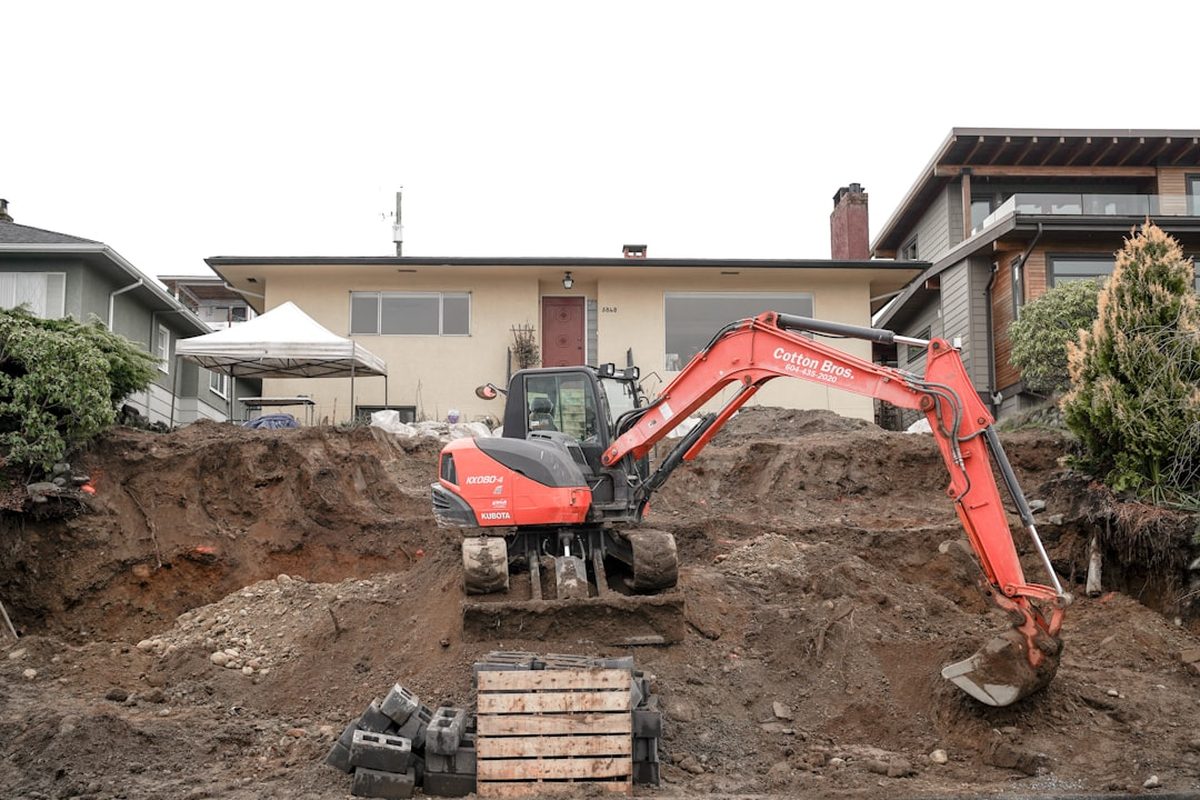
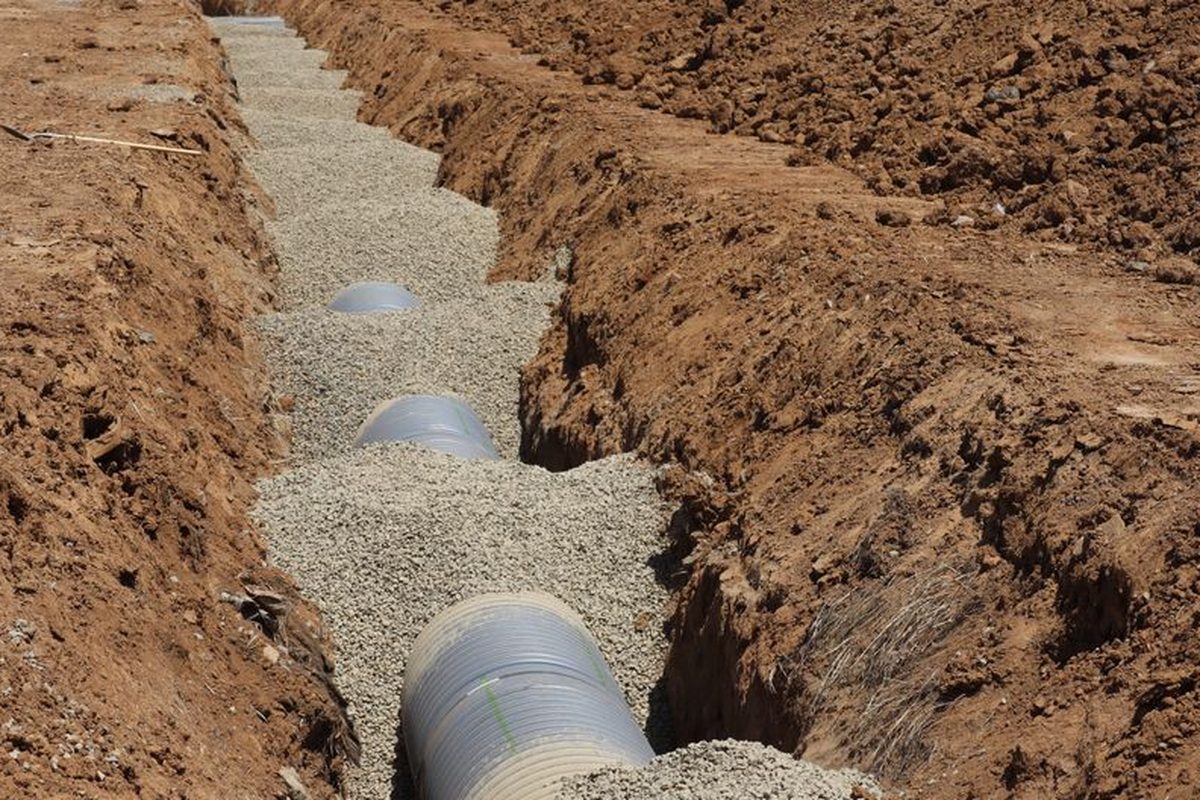
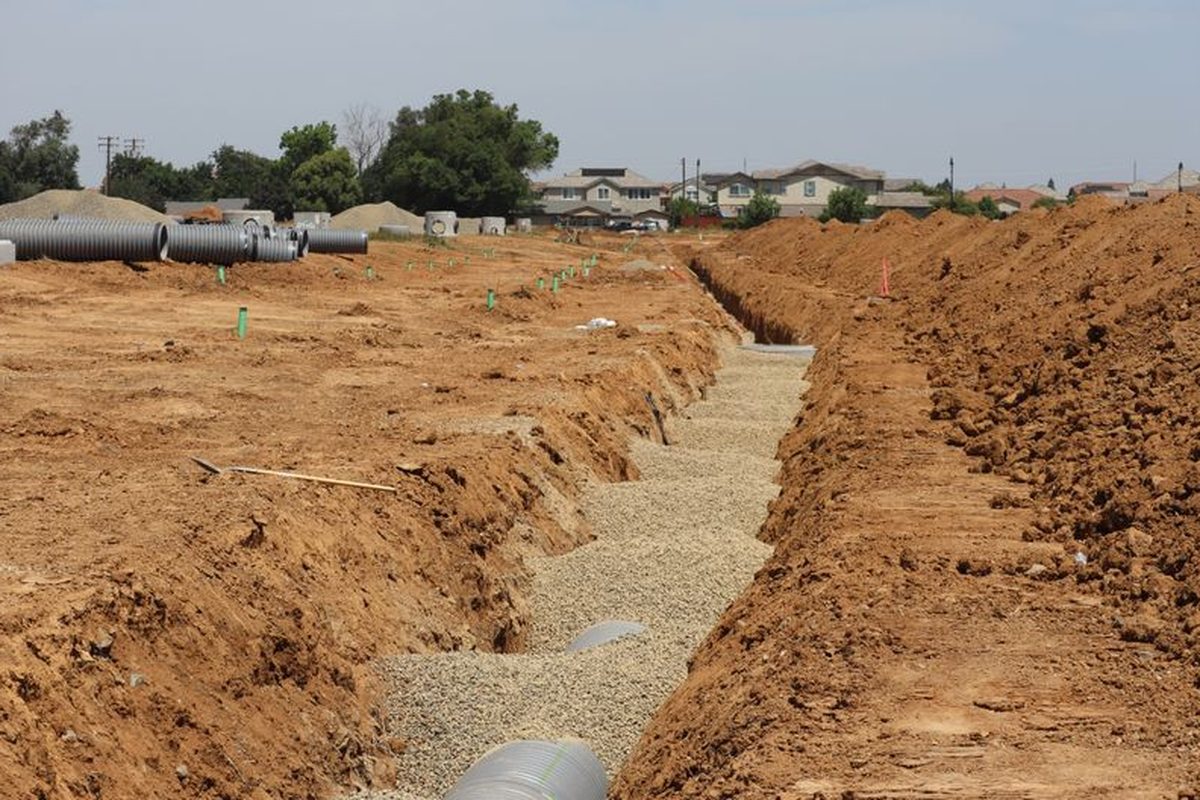
Illustrative photo of earthworks. We will add our own photos of completed projects as soon as they are available.
Frequently Asked Questions
Before you contact us
Can I still apply for the Dešťovka grant?
No. The Dešťovka II programme accepted applications until 11 October 2021 and has been closed since, even though many websites still advertise it. In Prague, the Čistá energie programme is running, offering up to 150 000 Kč for an accumulator tank in a detached house. Nationwide, the interest-free loan from Nové zelené úsporám remains available.
How long does the implementation take?
The construction itself usually takes two to four days, excavation and placement one day, backfilling and connection the rest. Preparation often takes longer: surveying, design and ordering of the specific tank.
Do I need a building permit?
A rainwater tank for a detached house usually does not require permission if it is used only for watering and the overflow is handled by an infiltration system on your own plot. Once you connect to the sewer or alter the site drainage, the situation changes, during our survey we will tell you what applies to you.
Can a tank be installed on an existing garden?
It is possible, but expect a strip of churned-up lawn where the machinery passed. We agree in advance on the excavator’s route and level the area upon handover. This is definitely not work that leaves the garden looking as it did before.
Is it worth it at all?
In terms of water bill savings alone, a five-cubic-metre tank pays back slowly, think in decades. It works out faster where you use the water inside the house, where you pay sewerage charges on rainwater, or where a Prague subsidy covers half the investment. We won’t claim this is an investment with a quick return.
Non-binding enquiry
We will state the price and whether a tank makes sense for you.
Tell us the size of your roof and garden and how you intend to use the water. We will get back to you with the volume, price, and whether a subsidy is viable in your case. If it does not make economic sense, we will tell you that too.
775 654 443Request for a tank
We will get back to you within the next working day.